 EN
EN

What a Rubber Washer Really Is
A rubber washer is a soft, compressible ring placed under a fastener or between flanges. It is not just a cushion. The part relies on elastic recovery to fill small gaps, resist media, and keep a clamped joint from leaking. Metal washers spread load. Rubber washers add sealing, vibration damping, and sometimes electrical isolation.
Common compounds include NBR, EPDM, silicone, neoprene, and FKM. Each reacts differently to oil, water, steam, ozone, and temperature. A washer that works in a fuel line may fail quickly in steam. Compound, hardness, and dimensions usually decide whether a joint stays dry after thermal cycling.
How Compression Turns a Soft Ring Into a Seal
A rubber washer prevents leaks by being squeezed. When a bolt tightens, the washer deforms and pushes back against the joint surfaces. That elastic pushback becomes the sealing force. It fills microscopic valleys in the metal and blocks the leak path between threads or flange faces.
Compression ratio, hardness, thickness, and surface finish are the key variables. A soft washer might be compressed 15 to 30 percent of its original thickness. Too little compression leaves gaps. Too much can crush the elastomer, cause permanent set, or push material outward. A 50 Shore A compound is soft and conformable. A 70 Shore A compound resists extrusion better but needs more bolt load to seal.
Where Leaks Begin and How Rubber Washers Stop Them
Leaks usually start at the washer-to-surface interface, around the fastener, or through the elastomer. A scratched flange face, a burr around a bolt hole, or a poor tightening pattern can create a path that torque alone will not close reliably. Rubber washers conform to minor imperfections, but they are not a fix for badly damaged sealing surfaces.
A chemical plant retrofit in southern China shows the point. A maintenance crew had repeated drips on a cooling water header after night shutdowns. Paper gaskets looked fine hot, but after the line cooled the joint wept. The crew switched to 70 Shore A NBR rubber washers and tightened bolts in a star pattern in three passes. NBR handled the cooling water and minor oil carryover, but the same compound would not be the first choice for a strong solvent line. ASME PCC-1 stresses uniform bolt load because uneven load leaves part of the joint under-sealed.
Picking the Right Rubber Compound for the Line
Material choice solves or creates many leak problems. Two rubber washers can share dimensions and still behave like completely different parts. The polymer backbone controls fluid resistance, temperature range, and aging behavior.
| Material | Typical service range | Good resistance | Weak spots |
|---|---|---|---|
| NBR | -30 C to 100 C | oil, fuel, water, glycol | ozone, ketones, strong acids |
| EPDM | -40 C to 120 C | water, steam, glycol, UV | petroleum oils, fuels |
| Silicone | -60 C to 200 C | high and low temperature, air | fuels, some oils, tear |
| Neoprene | -40 C to 100 C | refrigerants, mild chemicals | strong acids, esters |
| FKM | -20 C to 200 C | fuels, solvents, acids | hot water, steam, some amines |
Those ranges are starting points, not guarantees. Concentration, pressure, and cycle time all matter. A washer that passes a short dip test may still swell in continuous service.
Installation Choices That Keep a Joint Dry
Installation decides whether the rubber washer can do its job. The sealing surface should be clean, dry, and free of old gasket residue. Bolt threads should be clean and lubricated according to the joint design, because friction changes the relationship between torque and actual clamp load. Tightening should follow a cross or star pattern in several passes.
The inner diameter should clear the bolt without excessive play. The outer diameter should cover the sealing land without hitting the flange edge. Thickness should match the compression space. Stacking rubber washers to fill a gap is usually poor practice because the layers can shift and trap fluid. A single molded part is more reliable when a thicker seal is needed.
Limits, Failure Signs, and Selection Checks
Rubber washers are not universal. High pressure can extrude a soft compound into the clearance gap. Strong solvents can swell or dissolve certain elastomers. Extreme heat can harden the rubber and reduce elastic recovery.
Failure signs include flattening, cracks, a glossy surface, swelling, and black residue around the joint. A washer with permanent set may look intact but no longer push back enough to seal. When a joint leaks after thermal cycling, the washer is often the messenger, not the root cause.
For routine water and air, NBR or EPDM often works. For high-temperature or chemical service, FKM or a specialty compound may be required.
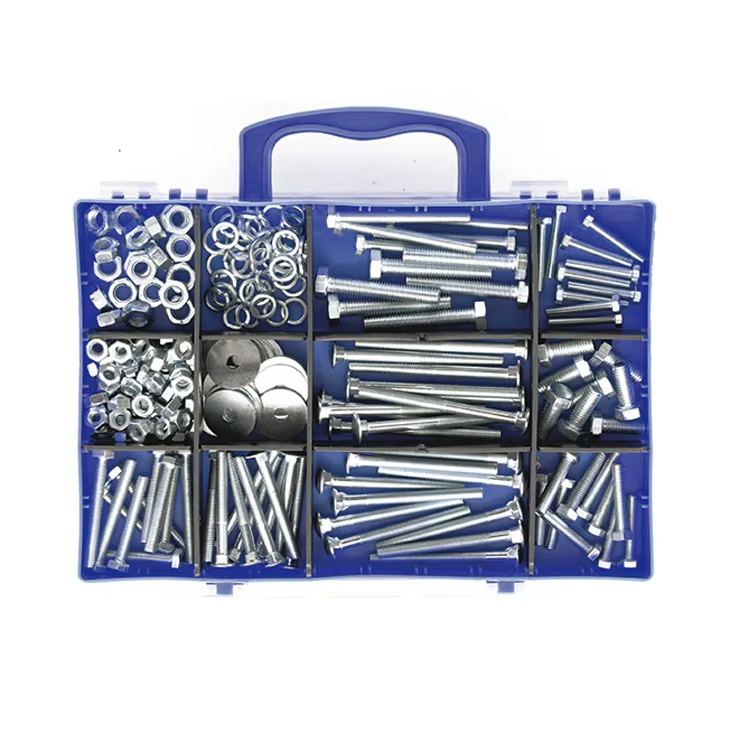
Zhongsheng Hardware has been making DIY hardware assortments and blister-packed kits since 1993, with PS, PP, ABS, and PVC packaging options and the ability to manufacture to buyer requirements. For distributors needing rubber washers, metal washers, and fasteners in retail-ready boxes, that manufacturing depth and supply chain coordination often matters as much as the part itself.