 EN
EN

Why Spring Washers Are Not Just Lock Washers
A spring washer is a formed metal part that stores elastic energy when compressed. That energy can hold preload as parts settle, absorb vibration, spread load, or bite into a mating surface. The common idea that every spring washer is a lock washer causes bad picks. A split ring and a wave washer can share a bin at a hardware counter, yet they solve different problems. Fastener references such as NASA RP-1228 and ASME B18.21.1 treat preload retention as a system issue. Bolt grade, joint stiffness, surface finish, torque method, and temperature all matter. A washer alone rarely saves a joint with no preload margin. The real question is what movement or relaxation needs to be controlled.
Split Lock Washers: The Familiar Helical Type
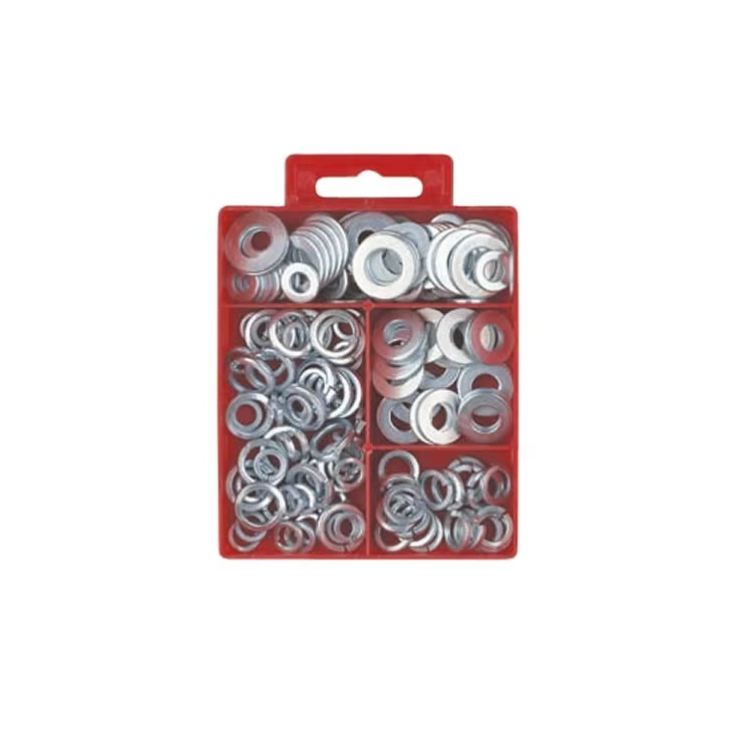
The split lock washer, often called a helical spring lock washer, has a gap and two raised ends. When the bolt tightens, the washer flattens and the ends press against the bearing surface and the nut or bolt head. The spring action adds a small amount of travel, and the sharp edges can dig in slightly. DIN 127 and ASME B18.21.1 cover many inch and metric sizes. This type works best on hard, clean surfaces and joints with mild vibration. On soft aluminum, the ends can gouge the surface. Under high vibration with short clamp length, a split washer may flatten and lose its bite. In a pump base retrofit at a chemical plant in southern China, standard split lock washers kept flattening on M20 bolts. The fix involved checking bolt stretch, adding hardened washers, and switching part of the joint to disc springs.
Wave Washers and Curved Washers: Axial Flex With a Lighter Touch
Wave washers have a wavy profile that creates multiple contact points around the circle. Curved washers, sometimes called crescent washers, have a single bow. Both provide axial spring travel with lower force than a disc spring. They help when thermal expansion, tolerance stack-up, or slight misalignment changes clamp length. Wave washers are common in bearings, electrical assemblies, and small mechanisms where light preload keeps parts from rattling. Curved washers appear in clutches, gearboxes, and linkages. The trade-off is load capacity. A thin wave washer cannot replace a heavy disc spring in a high-pressure flange. Material choice also matters. Spring steel, stainless steel, and beryllium copper appear in different catalogs. Corrosion resistance and magnetic behavior can decide the pick as much as spring rate. A wave washer that takes a set after compression is not springing back.
Belleville and Disc Springs: High Load in a Small Package
Belleville washers, also known as disc springs, are conical washers that deflect under load. Their shape gives high force over a short travel. Stacking in series increases travel. Stacking in parallel increases load. DIN 2093 is a common reference for dimensions and quality grades. These washers are used in bolted joints that need maintained preload, such as flanges, die systems, and heavy machinery. The load curve can be nonlinear. Near flat, small changes in deflection create large force changes. That behavior helps a designer who understands it and hurts a maintenance crew that treats a disc spring like a flat washer. Hardened surfaces and proper seating matter. A disc spring on a rough casting can lose preload through embedment. In one food processing plant, disc springs solved a thermal cycling problem on a heat exchanger, but only after bolt holes were spot-faced and stack height was recalculated.
Serrated, Finger, and Specialized Spring Washers
Serrated washers have teeth or ridges that bite into the mating surface. They provide higher friction and resistance to rotation, but they can damage plated or painted surfaces. Internal and external tooth styles distribute contact differently. Finger washers use raised tabs that act as springs and locking features. They are common in shaft assemblies and light-duty mechanisms. A serrated washer may be a poor choice for a soft brass terminal, while a finger washer may be wrong for a high-load structural bolt. Standards and catalog data help, but the joint still needs a real check. Hardness, coating, and mating material determine whether the washer locks, relaxes, or damages the joint.
How to Choose the Right Spring Washer for a Joint
Start with the joint, not the washer. Define bolt preload, clamp length, vibration direction, temperature range, and surface hardness. Then compare spring travel, load, and contact style. The table below gives a practical starting point.
| Type | Typical load | Spring travel | Locking action | Common reference |
|---|---|---|---|---|
| Split lock washer | Low to medium | Low | Edge bite and slight spring | DIN 127, ASME B18.21.1 |
| Wave washer | Low | Medium | Light preload, anti-rattle | DIN 137 |
| Curved washer | Low to medium | Medium | Preload and take-up | Manufacturer data |
| Belleville disc spring | High | Low, stackable | Maintained preload | DIN 2093 |
| Serrated washer | Medium | Very low | Tooth friction | DIN 6797, DIN 6798 |
| Finger washer | Medium | Medium | Tab spring and lock | Manufacturer data |
A washer that works on a bench test can fail on a vibrating machine if the bolt loses preload. Torque alone is a weak predictor. Bolt stretch, friction, and embedment decide what remains. Buyers should ask for material certs, hardness ranges, and coating details. For OEM and DIY hardware programs, consistent sorting and packaging matter as much as the stamping. Zhongsheng has supplied hardware assortments since 1993, with in-house blister packaging in PS, PP, ABS, and PVC and the process control needed for mixed fastener kits. The right spring washer is the one matched to the joint, not the one that looks most aggressive.
Table of Contents
- Why Spring Washers Are Not Just Lock Washers
- Split Lock Washers: The Familiar Helical Type
- Wave Washers and Curved Washers: Axial Flex With a Lighter Touch
- Belleville and Disc Springs: High Load in a Small Package
- Serrated, Finger, and Specialized Spring Washers
- How to Choose the Right Spring Washer for a Joint