 EN
EN

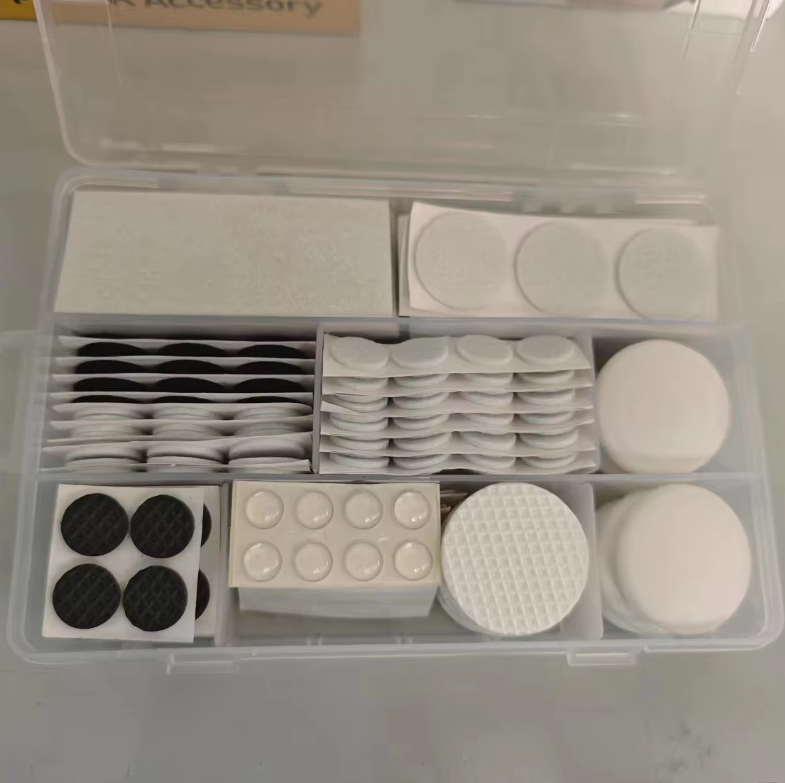
Why Felt Pads Still Deserve a Spot in Modern Furniture Hardware
Self-adhesive felt pads are one of those small components that rarely get attention until a floor gets scratched or a cabinet door starts to rattle. The basic idea is simple: a dense felt disc or strip, coated on one side with a pressure-sensitive adhesive, bonds to the bottom of a chair, vase, lamp, or drawer. The felt side faces the floor or another surface. For furniture makers, upholsterers, and DIY hardware packagers, felt pads offer a low-profile way to solve several problems at once: friction, impact noise, and surface marring. Unlike bulky glides or metal casters, self-adhesive felt pads add only a millimeter or two of height, so they fit into tight tolerances. That matters in ready-to-assemble furniture, where a few tenths of a millimeter can decide whether a drawer front sits flush.
Surface Protection That Goes Beyond Scratch Prevention
The most obvious advantage is floor protection. Hardwood, laminate, vinyl plank, and ceramic tile all suffer when hard furniture feet slide across them. Sand and grit trapped under a leg act like sandpaper. A felt pad creates a soft interface that conforms slightly to the floor, spreading load over a wider area and reducing point pressure. The result is less scratching and less wear on the finish. There is also an acoustic benefit. Felt fibers absorb high-frequency vibration, so the scrape of a dining chair or the clunk of a stool becomes a duller sound. In offices and hotels, that reduction can improve comfort without complex mechanical systems. Felt also handles minor surface irregularities. On slightly uneven tile, a felt pad can bridge small gaps that would cause a hard plastic glide to rock or chip. It is not a cure for major floor damage, but it is a practical first line of defense.
Adhesive Backing: The Quiet Engineering Behind Peel-and-Stick
The adhesive side is where many cheap pads fail. A pressure-sensitive adhesive needs a clean, dry surface. Oil, dust, or mold release agent on a furniture foot can cut peel strength dramatically. Good self-adhesive felt pads use a rubber or acrylic adhesive with a release liner that protects the glue until installation. Once pressed, the adhesive wets out the surface and forms microscopic mechanical interlocks. According to ASTM D3330, a standard test method for peel adhesion of pressure-sensitive tape, measured peel strength depends on dwell time, temperature, and substrate. A 24-hour dwell at room temperature often gives a stronger bond than an immediate pull test suggests. Surface preparation matters more than brute force. Wiping the foot with isopropyl alcohol and letting it dry can make the difference between a pad that stays put and one that slides off in a week.
Where Felt Pads Make Sense and Where They Fall Short
Self-adhesive felt pads are not a universal answer. They shine on indoor furniture that moves occasionally: chairs, stools, tables, display stands, and small appliances. They are less suitable for constant heavy sliding, outdoor use, or wet areas. Moisture can soften felt fibers and weaken some adhesives. On rough concrete or deeply textured stone, the felt may wear quickly because the surface acts like a rasp. Very heavy loads can compress felt over time, reducing thickness and cushioning. In those cases, a nylon glide, rubber cup, or metal leveling foot may be a better fit. Temperature also matters. In a cold warehouse, some acrylic adhesives become stiff and tack less aggressively. In a hot car or near a radiator, rubber adhesives may soften and creep. The honest take: felt pads are excellent for light-to-medium indoor protection, but they need realistic expectations and the right adhesive for the environment.
A Retrofit Case, Material Comparison, and the Packaging Angle
During a retrofit at a chemical plant in southern China, an installation crew was replacing lab benches and rolling carts in a quality-control room. The floor was epoxy-coated and expensive to repair. Metal feet were leaving dark scuff marks and generating a sharp screech every time a cart moved. The team tried standard rubber caps, but they left black residue and felt too grippy for carts that needed short slides. Self-adhesive felt pads with an acrylic adhesive solved the scuffing and cut the noise, while still allowing controlled movement. The pads were replaced every few months in high-traffic lanes, which was acceptable because the floor stayed intact. That trade-off is common: felt pads may wear faster than the floor they protect, and that is often the point.
| Material | Typical thickness | Surface protection | Noise reduction | Best for |
|---|---|---|---|---|
| Felt pad | 1-6 mm | High | Good | Indoor furniture, light carts |
| Rubber cup | 3-10 mm | Medium | Moderate | Gripping stability |
| Nylon glide | 2-8 mm | Medium | Low | Heavy sliding |
| PTFE glide | 1-5 mm | Medium | Low | Smooth low-friction movement |
For brands packaging DIY hardware, felt pads often appear in assortment boxes with screws, anchors, bumpers, and glides. Zhongsheng Hardware has built its business around that combination, with decades of experience in DIY hardware assortments and plastic-absorbing boxes, supporting consistent felt pads, mixed sets, and custom packaging.