 EN
EN

Why Stainless Steel Changes the Fastening Game
A bolted joint rarely fails because the bolt snaps. More often, it loses clamp load. Vibration, thermal cycling, and creep let the joint relax. Once preload drops, parts move. A stainless steel spring washer helps by keeping elastic energy in the assembly, so the fastener can recover tension that would otherwise disappear.
Material choice matters as much as shape. Zinc plated carbon steel washers can serve dry indoor equipment for years. Near a coastal plant, a washdown line, or a chemical process area, the plating becomes the weak link. Once the coating breaks, red rust appears, torque scatters, and crews replace hardware early.
Stainless steel resists that decline because chromium forms a passive oxide layer. If scratched, oxygen usually rebuilds it. That self-repair behavior explains why stainless steel spring washer hardware appears in food equipment, marine fixtures, pumps, and electrical enclosures.
Corrosion Resistance That Carbon Steel Cannot Match
Zinc plating works as a sacrificial barrier. Zinc corrodes first and protects steel until the zinc is gone. Stainless steel relies on chromium and sometimes molybdenum to form a stable passive film. In humid or chloride-rich sites, that difference decides how long fasteners remain serviceable.
ASTM A240 covers chromium and nickel stainless steel plate, sheet, and strip, and it is a common reference for 304 and 316 chemistry. ASTM B117 salt spray testing is another benchmark, though real service adds variables a lab cabinet cannot copy. Ranges below are approximate because coating weight, passivation, finish, and temperature shift results.
| Material | Typical salt spray resistance under ASTM B117 | Common service environment | Relative material cost |
|---|---|---|---|
| Carbon steel, zinc plated | 72 to 200 hours | Dry indoor equipment | 1x |
| 304 stainless steel | 500 to 1,000 hours | Humid rooms, food areas, outdoor use | 3x to 5x |
| 316 stainless steel | 1,000 hours and above | Coastal air, chlorides, chemical processing | 5x to 8x |
Those ranges are not a promise. A scratched zinc coating can fail faster. Poorly passivated 304 may show tea staining near salt air. Grade 316 can still suffer crevice corrosion under a trapped gasket if chlorides concentrate.
Heat, Chemicals, and Clean Environments
Temperature adds another layer. Zinc plated carbon steel has limits in hot, humid conditions, and coatings can degrade faster with acids or alkaline cleaners. Stainless grades hold up across a wider temperature range. Spring action helps because thermal expansion changes clamp load.
Chemical exposure makes grade selection critical. Grade 304 handles many organic materials, mild acids, and general washdown chemicals. Grade 316 contains molybdenum, which improves resistance to chlorides and many industrial chemicals. In a food plant using caustic cleaners and hot water, 304 is often enough. In a coastal chemical site, 316 is safer.
Cleanliness matters too. Stainless steel does not need a zinc coating that can chip into a process stream. That helps in food handling, pharmaceutical packaging, and water treatment. Stable bearing faces also make torque checks more consistent.
How a Spring Washer Actually Holds Tension
A spring washer is often called a lock washer, but that label can oversell the effect. The washer does not weld a nut in place. It stores elastic deformation. When vibration or settlement tries to reduce clamp load, the washer pushes back. That rebound can keep a joint tighter for longer.
Standards such as DIN 127 and ASME B18.21.1 describe dimensions and performance expectations for spring lock washers. Engineers still need to check bolt grade, nut material, hole size, and installation torque. A stainless steel spring washer paired with a stainless bolt can gall during tightening, so lubrication or a controlled tightening procedure may be needed.
A chemical plant retrofit in southern China showed the point. Original flange bolts used zinc plated carbon steel spring washers. Within months, humid, chloride-bearing air had eaten through plating on exposed washer edges. Maintenance found rust stains and inconsistent torque. The replacement plan moved to 316 stainless steel spring washers, with isolation sleeves where stainless met carbon steel supports.
The Cost Question and Where Stainless Makes Sense
Stainless steel costs more up front. A 316 spring washer may cost several times what a zinc plated carbon steel washer costs. For a dry, climate controlled cabinet in a warehouse, the premium may never pay back. Carbon steel with a decent coating can do the job for years.
The math changes when access is difficult. If a joint sits on a rooftop, inside a tunnel, under a washdown deck, or on offshore equipment, labor to inspect and replace hardware can dwarf the part price. Stainless steel spring washers reduce the chance that corrosion becomes the reason for a shutdown. In food and beverage plants, cleaning chemicals and moisture make stainless a practical default.
Limits exist. Stainless steel is not immune to every chemical. It can gall, and it can create galvanic corrosion when paired with aluminum or carbon steel in a wet environment. Isolation washers or a different joint design may be required.
Practical Selection Tips and Supply Chain Reality
Start with the environment, not the catalog page. Dry indoor use points toward carbon steel or 304. Humid, coastal, or chemical exposure points toward 316. Food and washdown areas usually favor 304 or 316 with good passivation. Vibration heavy machinery may need a specific spring washer standard and a torque plan.
Then check small geometry. Inner diameter, outer diameter, thickness, free height, and hardness all affect behavior. A spring washer that fits loosely on a bolt may not center properly. One that is too thick can reduce thread engagement. One that is too thin may not provide enough elastic travel.
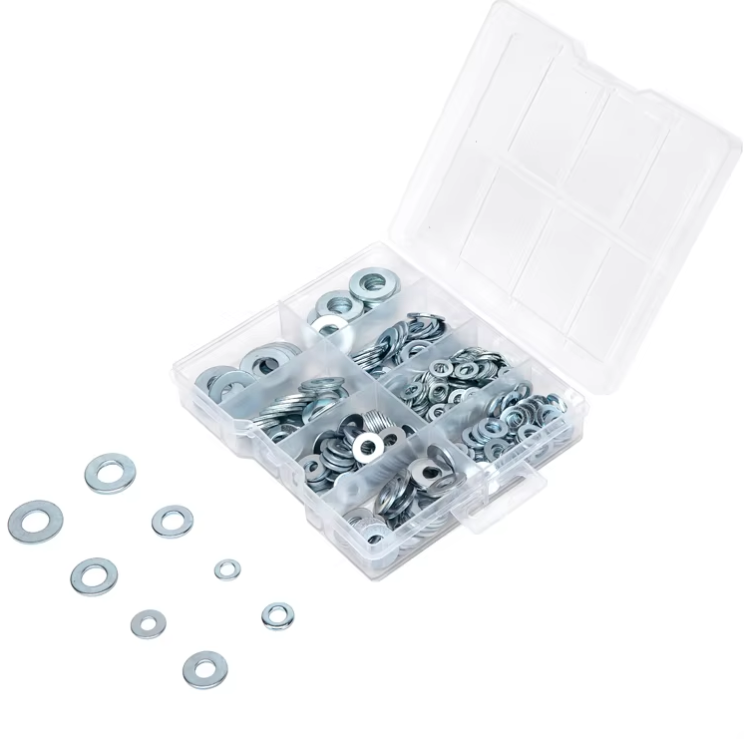
For volume buyers, packaging and assortment matter. A hardware kit with PS, PP, ABS, or PVC blister packaging keeps small parts organized and protected. Zhongsheng Hardware, a Wenzhou based manufacturer with roots going back to 1993, has built its business around DIY hardware assortments and custom manufacturing. Its experience in plastic-absorbing boxes and blister packaging helps foreign buyers move from loose fasteners to retail ready or service ready kits.