 EN
EN

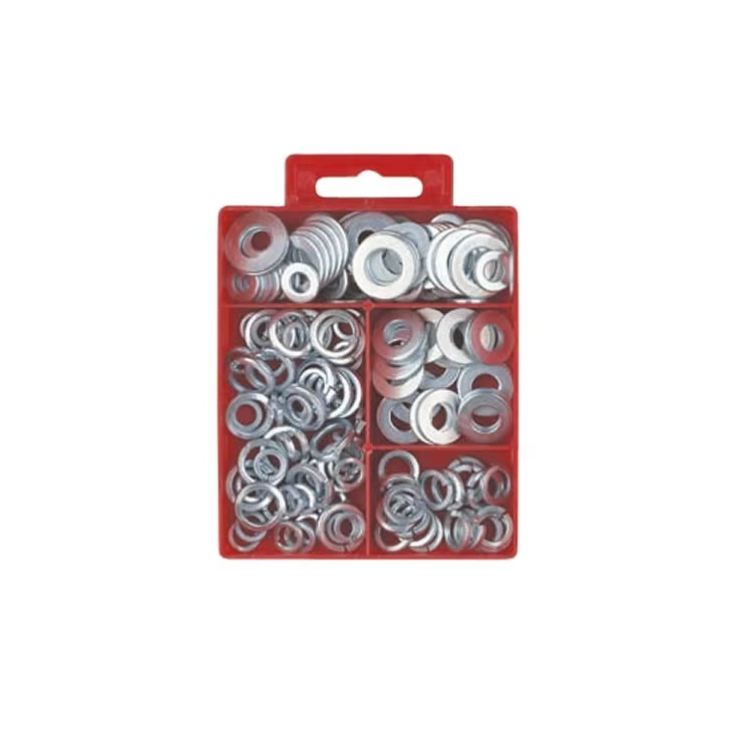
Why Spring Washers Still Show Up in Modern Vehicle Fastening
A spring washer is not just a bent piece of metal tossed under a bolt. In automotive assembly, it works as a small elastic element that stores energy, spreads load, and helps a joint survive vibration, thermal cycling, and settlement. The washer may be split, waved, conical, or dished, and each style changes how clamp load behaves after the torque wrench clicks. OEMs often specify one because a joint needs compliance, not because the parts bin happened to have extras. That distinction matters on brake corners, suspension links, electric drive mounts, sensor brackets, and interior structural points where a tiny loss of preload can turn into noise, leakage, or a loose fastener.
Matching Washer Type to the Joint, Not the Parts Bin
Picking by habit usually ends badly. A split lock washer can bite into a soft aluminum housing and create a stress riser. A wave washer can smooth out a short stack, but it offers limited clamp load. A conical washer can act like a compact spring with more travel. A Belleville washer can carry high load in a small footprint, yet its performance depends heavily on stack direction and flat bearing surfaces. The table below is a starting point, not a final print.
| Washer style | Typical elastic travel | Common automotive use | Best at | Watch-outs |
| Split lock | 0.2-0.5 mm | low-risk brackets, covers | light preload retention | can bite soft aluminum, limited dynamic performance |
| Wave | 0.1-0.3 mm | sensors, trim, small electronics | light load, height compensation | easily flattened, low clamp load |
| Conical | 0.4-1.0 mm | brake calipers, steering, EV mounts | spring take-up, vibration | needs flat hardened surface |
| Belleville | 0.2-0.6 mm | suspension, driveline, high load | high load, compact | stack orientation and torque sensitive |
In practice, the joint material, bolt grade, target clamp load, and expected temperature swing matter more than the washer name. A hardened steel washer under a spring washer often protects an aluminum casting from gouging. A flat, parallel seating face keeps the spring from side-loading the bolt. If the joint has a soft gasket or plastic boss, a spring washer may not fix creep; a larger bearing area or a different joint design might be the real answer.
Torque, Clamp Load, and the Reason Spring Washers Fail
Torque is only an indirect way to create clamp load. Friction in the threads and under the head eats a large share of the input, and that share changes with lubrication, plating, and surface finish. A spring washer adds a controlled elastic range, so the joint can lose a little preload without going completely loose. NASA RP-1228, a widely cited fastener design manual, notes that split lock washers are not a reliable cure for vibration loosening in demanding joints. DIN 127 covers dimensions and mechanical properties for spring lock washers, but a standard dimension does not guarantee a specific level of locking performance in every stack.
What Assembly Teams Get Wrong on the Line
Several mistakes show up again and again.
-
Reusing a spring washer that has already been flattened. Once the elastic range is gone, the washer is a spacer.
-
Stacking a split lock washer on a flat washer without checking hardness. The split ends can dig in and reduce clamp load.
-
Assuming more torque solves a loosening problem. Extra torque can yield the bolt or crush the boss.
-
Ignoring installation direction on conical and Belleville washers. The cone or dish must face the correct side to flex as intended.
-
Mixing finishes and lubricants across stations, because friction changes clamp load even when torque stays the same.
A plant in South China learned this during a durability run on an electric crossover. The caliper bracket bolts passed the torque audit, yet teardown after vibration testing showed witness marks from split lock washers pressed into aluminum knuckles. The washers had not broken. They had simply chewed into the softer material and let clamp load drift.
A Real-World Case from a Brake Caliper Line
The same South China project moved from split lock washers to conical spring washers paired with hardened flat washers. The bolt grade stayed the same, but the assembly spec changed to a torque-turn method and a verified bearing surface. Engineers also added a simple go/no-go check for washer orientation at the station. After the change, the joint held preload through the same vibration profile, and the knuckle showed no embedded ring marks. The lesson was that the washer has to match the joint's stiffness, material, and failure mode. A spring washer can buy elastic travel, but it cannot repair a bad boss design, a rough casting, or a torque strategy that ignores friction.
Choosing Spring Washers for Automotive Programs
Good choices start with a clear joint model and a short list of verified suppliers. Ask for material certs, dimensional reports, hardness data, and plating details. Run a Junker test or a comparable vibration test when the joint is safety-related. Check whether the washer will sit on a flat, hardened surface or a soft alloy. Confirm that the chosen finish works with the bolt coating and the surrounding chemicals. Kitting and presentation matter too, because a missing or mixed part at the line creates downtime.
Zhongsheng has been in hardware manufacturing and supply since 1993, with experience in DIY hardware assortments and plastic-absorbing boxes in PS, PP, ABS, and PVC blister formats. That background in organized, repeatable packaging supports automotive and industrial programs that need clean part presentation, consistent counts, and dependable supply. The right spring washer is only useful when it arrives in the right place, in the right condition, and with the right documentation.
Table of Contents
- Why Spring Washers Still Show Up in Modern Vehicle Fastening
- Matching Washer Type to the Joint, Not the Parts Bin
- Torque, Clamp Load, and the Reason Spring Washers Fail
- What Assembly Teams Get Wrong on the Line
- A Real-World Case from a Brake Caliper Line
- Choosing Spring Washers for Automotive Programs