 EN
EN

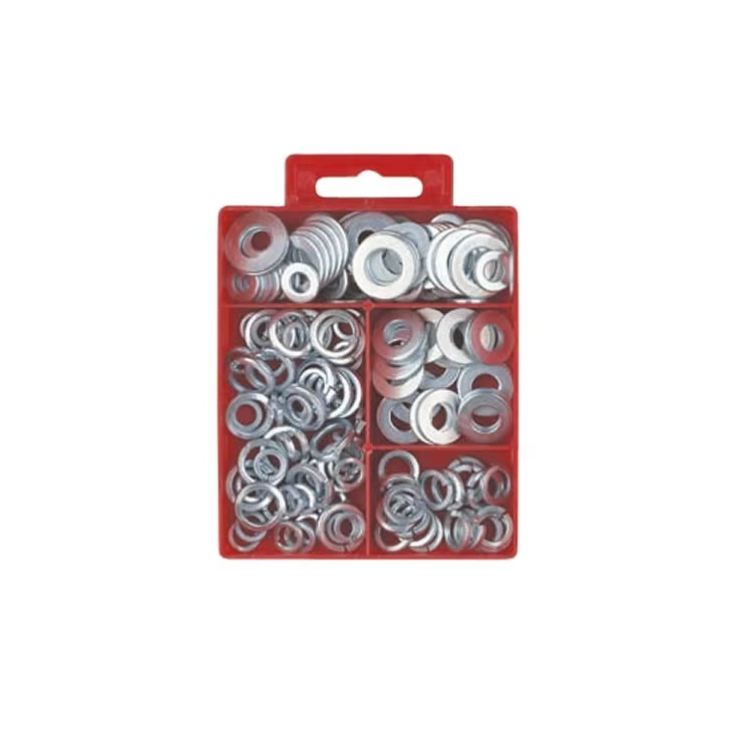
Why Tension Disappears from a Spring Washer
A spring washer is not a cure-all for vibration. It is an elastic element that stores energy when compressed and releases it when the joint tries to separate. A split lock washer, often called a spring washer, creates axial force against the bolt head and clamped parts. That force helps maintain clamp load, but it lives inside a narrow elastic range. Once the washer flattens, overheats, or embeds into a soft surface, the reserve is gone.
Several forces work against that reserve: embedding, vibration, thermal cycling, gasket creep, and reuse. Junker tests, described in DIN 65151, compare locking methods under transverse vibration. Published results often show that a standard split spring washer can lose clamp load quickly when sliding begins. The part still works when matched to the joint, torque, and operating conditions.
Torque, Contact, and the Installer's Role
Torque specs matter. Too little torque and the bolt never stretches enough. Too much torque and the spring washer can flatten into dead metal. Friction steals part of the torque. Dry threads, oiled threads, zinc plating, and stainless steel all change the torque-to-clamp-load relationship.
Surface contact is another factor. A rough casting embeds the washer faster than a machined flange. Paint, rust, and burrs create high spots that collapse after a few thermal cycles. A clean, flat, parallel face gives the washer a better chance to keep tension.
For critical joints, torque alone is weak. Auditing torque and checking free height after teardown reveal whether the spring washer is doing real work. A washer that comes off nearly flat suggests the joint lost preload long before the maintenance check.
Material and Heat Treatment Decide Elastic Reserve
Not all spring washers behave the same. Carbon steel washers, often 65Mn, depend on heat treatment for hardness and elasticity. Stainless steel resists corrosion but can gall and may have lower spring properties depending on alloy and condition. Phosphor bronze appears in electrical or marine hardware, yet it is not a drop-in replacement for steel in high-load joints.
Standards such as DIN 127 and ASME B18.21.1 give dimensions and some material guidance. They do not guarantee performance in every joint. Hardness matters. A washer that is too soft will flatten and stay flat. A washer that is too hard may crack at the split. Consistent heat treatment is the quiet difference between a washer that survives assembly and one that fails after a few thermal cycles.
Reuse and a Real-World Failure Pattern
Reuse is one of the most common causes of lost tension. A spring washer is designed to work in its elastic range. After one strong compression, especially with over-torque, the washer may take a permanent set. Free height drops. The next installation starts with less reserve.
During a retrofit at a chemical plant in southern China, a maintenance team found repeated leaks on pump flange bolts. The bolts were tight at the start of each shift, but vibration and thermal cycling loosened them. Teardown showed many spring washers had been reused three or four times. Their free height was 0.3 mm to 0.5 mm lower than new samples. The fix was simple: new washers, clean contact faces, calibrated torque, and a tag system to stop reuse. Leak calls dropped after the next shutdown.
If a spring washer has been crushed, heated, or removed from a loaded joint, it should not return to a critical application. For low-risk furniture or shelf assembly, reuse may be tolerated. For pumps, motors, and pressure joints, it is a gamble.
Design Choices and a Practical Tension Checklist
Good hardware cannot rescue a bad joint design. Several details help a spring washer keep tension:
-
Use a hardened washer under the bolt head when the joint material is soft.
-
Control thread lubrication so torque translates into consistent clamp load.
-
Avoid over-torque that flattens the spring washer.
-
Check bolt length. Too much unthreaded shank can limit stretch.
-
Consider a serrated flange or wedge-locking washer for severe vibration.
-
Inspect contact faces for paint, burrs, and poor parallelism.
The table below comes from representative shop-floor checks, not a controlled laboratory guarantee.
| Condition | Relative clamp load after 500 vibration cycles | Field note |
|---|---|---|
| New split spring washer, dry threads | 72% | Baseline for a clean joint |
| Reused spring washer, oiled threads | 48% | Free height already reduced |
| New spring washer, correct torque, clean faces | 86% | Best result in the group |
| Over-torqued spring washer, flattened | 55% | Elastic reserve lost |
| Heat-treated 65Mn washer, controlled hardness | 82% | Less embedding and better recovery |
The numbers are directional. Real joints vary with bolt size, coating, gasket, and load direction. A spring washer works best when it stays elastic, sits on a stable surface, and is installed with the right clamp force.
For buyers building hardware kits, Zhongsheng has produced blister-packed DIY hardware assortments since 1993, with control over material selection, heat treatment monitoring, and packing consistency. PS, PP, ABS, and PVC blister packaging helps keep mixed sets organized for retail or industrial use.