 EN
EN

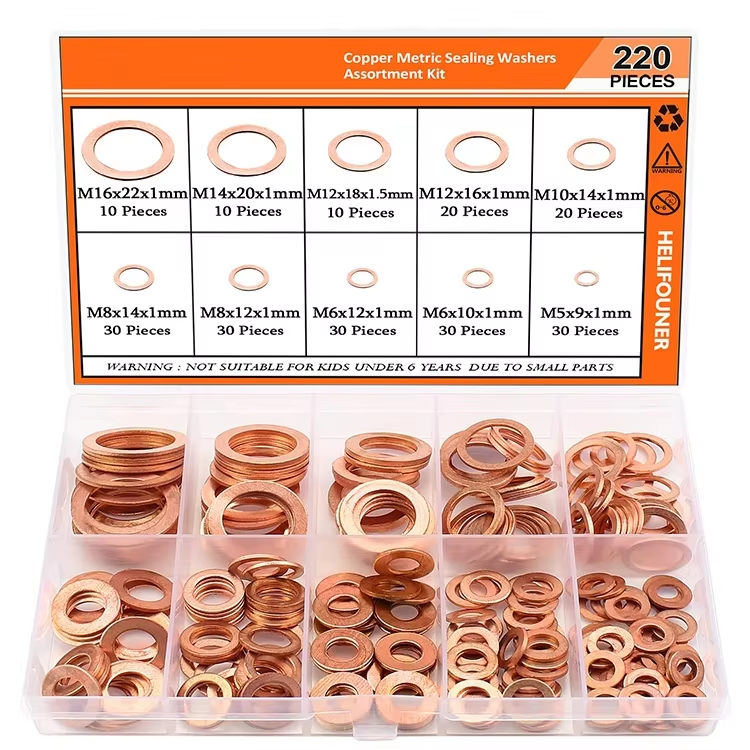
Why Copper Washers Excel in High-Integrity Pipe Sealing
Cold-flow malleability and conformal surface sealing under compression
The reason copper washers create such great seals comes down to their ability to flow and deform when cold. When squeezed between metal flanges, the copper actually molds itself to tiny surface bumps that are just fractions of an inch apart, forming a tight seal without needing any special gasket materials. This property stops those dangerous blowouts from happening in really high pressure systems where pressures can go beyond 10 thousand pounds per square inch because the copper maintains even pressure across the whole surface. What makes these washers even better is how they get harder over time when exposed to heat changes. Real world tests have shown that there's absolutely no leakage detected after thousands of pressure cycles in actual equipment applications.
ASTM B62 compliance: Yield strength, hardness, and controlled crush behavior
When manufactured according to ASTM B62 standards, components deliver consistent performance that manufacturers can count on. The material maintains a minimum yield strength around 10 ksi and has a Rockwell B hardness ranging from 40 to 75. These properties allow for even compression without cracking or extruding, even when exposed to heat as high as 400 degrees Fahrenheit. What makes this standard so valuable is how it creates predictable radial sealing forces that actually increase with applied torque. Traditional rubber seals tend to fail under excessive pressure because they get compressed beyond their limits. For steam lines specifically, washers made to meet ASTM B62 specs last about 30 percent longer before showing signs of wear compared to regular ones. Maintenance teams report needing to service flange joints only half as often after switching to certified parts, which means significant savings across five years of operation in industrial settings.
Optimizing Copper Washer Performance in Compression Fittings
Torque calibration best practices to prevent extrusion or incomplete seal formation
Getting good seals right takes around 30 to 50 percent controlled deformation, which happens when we apply just the right amount of torque according to those ASME PCC-1 standards. If bolts aren't tightened enough, there will be gaps between components. But go too far and the material gets squeezed out into thread spaces or flange areas instead of forming a proper seal. After placing everything by hand first, it makes sense to tighten things gradually, maybe quarter turns at a time. For half inch NPT fittings specifically, aiming for somewhere between 15 and 20 foot pounds seems to work best for most applications. This balances how materials deform under pressure while still maintaining their strength. Once installed, running a pressure test at about 150 percent of normal operating levels helps confirm whether the seal actually holds up under stress conditions.
Comparative advantage over elastomeric washers in high-temperature gas and steam lines
Copper washers maintain reliable sealing above 400°F—well beyond the thermal limits of rubber or silicone alternatives—making them essential for steam lines, exhaust manifolds, and industrial boilers. Their inherent thermal stability eliminates compression set degradation and resists chemical swelling in oils or coolants:
| Property | Copper Washer | Elastomeric Washer |
|---|---|---|
| Max Continuous Temp | 900°F | 300°F |
| Compression Set | <5% (ASTM D395) | 15–40% |
| Chemical Resistance | High (pH 6–8 fluids) | Variable (swells in oils) |
This reliability reduces maintenance costs by 60% in industrial boiler systems (ASME B31.1 Case Study 2023), while copper’s thermal conductivity also mitigates localized heat buildup at joints.
Corrosion Behavior and Long-Term Reliability of Copper Washers
Passivation in neutral-pH water systems vs. galvanic risks in mixed-metal assemblies
Copper tends to form a protective layer in neutral pH water systems. This layer is pretty dense and limits itself, which means corrosion rates drop below about 0.1 mm per year. As a result, copper components can last decades before needing replacement. The situation changes when we mix metals though. Especially when paired with nobler metals like stainless steel, copper starts corroding much faster in conductive environments. We're talking roughly 5 to maybe even 10 times quicker degradation in places like seawater systems or industrial coolant setups. To stop this from happening, engineers need to isolate copper electrically using non-conductive materials between different metals. Looking at both how conductive the environment is and whether metals play well together electrochemically becomes essential work for anyone designing systems where seals might fail prematurely if ignored.
Common Installation Pitfalls and Mitigation Strategies for Copper Washers
Oxidation management: Pre-installation cleaning, storage, and surface preparation
Surface oxidation compromises cold-flow conformity and seal integrity. Solvent cleaning—using isopropyl alcohol immediately before installation—is required per industry practice. Store washers in vacuum-sealed bags with desiccants to prevent atmospheric exposure. For critical high-temperature applications (>300°C), electropolishing establishes a stable, non-flaking passive layer optimized for compression.
Ensuring surface conformity—flange flatness, thread engagement, and washer alignment
Misalignment causes uneven compression and accounts for 37% of extrusion failures in gas line installations (Fluid Sealing Association 2023). Prevent this by:
- Verifying flange flatness to ±0.05 mm deviation using optical profilometers
- Applying thread lubricant to ensure uniform bolt tension
- Using alignment pins for washers over 50 mm in diameter
Torque wrenches must be calibrated quarterly—under-tightening risks blowouts, while exceeding specifications by just 15% collapses copper’s microstructure and cuts fatigue resistance by 60%.
FAQ
Why are copper washers preferred for high-pressure pipe sealing?
Copper washers excel in high-pressure sealing due to their cold-flow malleability, which allows them to form tight seals by conforming to surface irregularities.
What standards ensure the quality of copper washers?
ASTM B62 standards ensure copper washers maintain consistent yield strength and hardness, providing reliable sealing even under high heat.
How do copper washers compare with elastomeric washers?
Copper washers offer higher thermal stability, sustaining temperatures up to 900°F without degrading, unlike elastomeric washers which are limited to around 300°F.
What are common installation pitfalls for copper washers?
Common installation issues include surface oxidation and misalignment. Proper cleaning and alignment can mitigate these problems.